
First U.S. surgeon to implant dynamic spine is Gladstone native
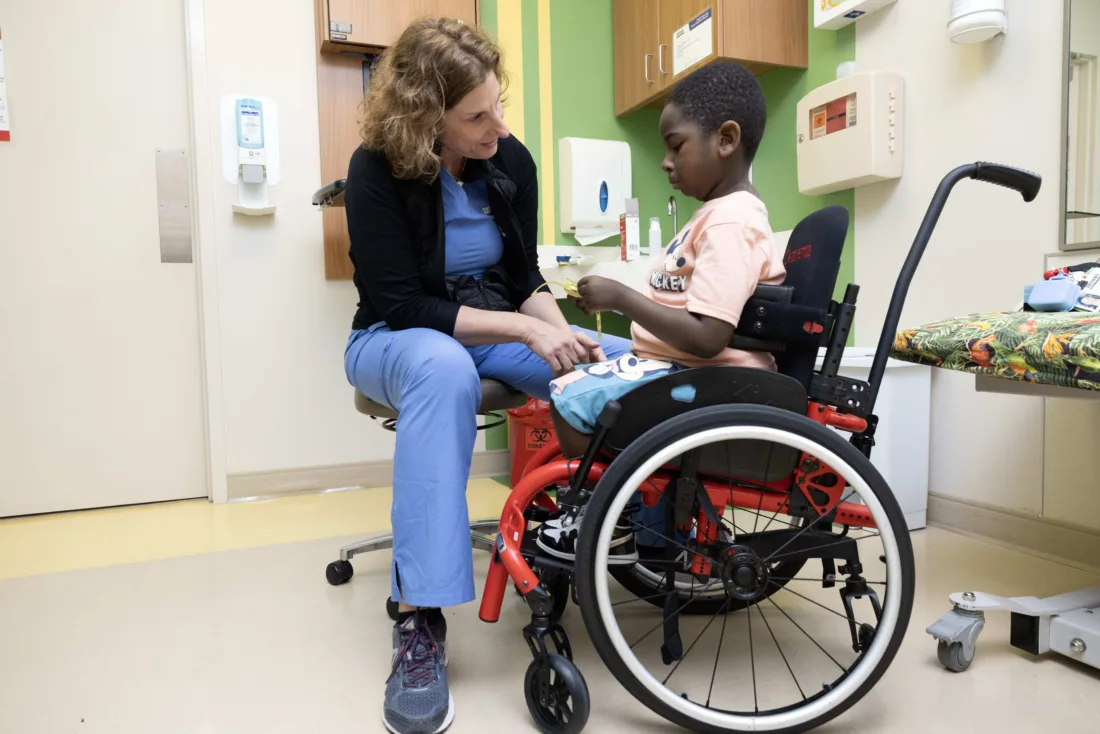
Amy McIntosh, M.D., meets with patient Kingston Brown, age six, during a follow-up appointment after his scoliosis surgery. The boy was the first child in the United States to receive a new type of spinal implant. The procedure was executed by McIntosh, originally from Gladstone. (Photo courtesy of Scottish Rite for Children)
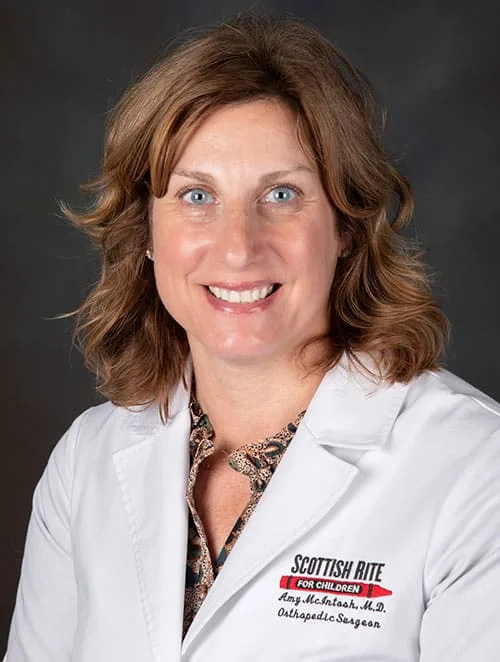
Dr. Amy McIntosh, formerly Bradfield, recently made history by becoming the first surgeon in America to implant a new device for children with spinal deformities. She grew up in Gladstone, Michigan. (Photo courtesy of Scottish Rite for Children)
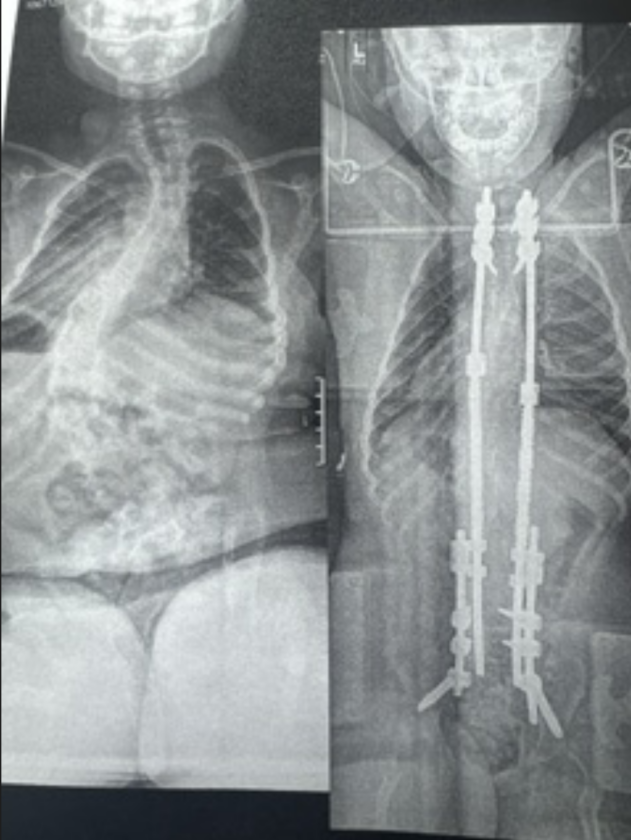
Before and after scans show how a child's highly-curved spine has been corrected using the Cresco Spring Distraction System, which will expand as the youngster grows. (Courtesy of Scottish Rite for Children)
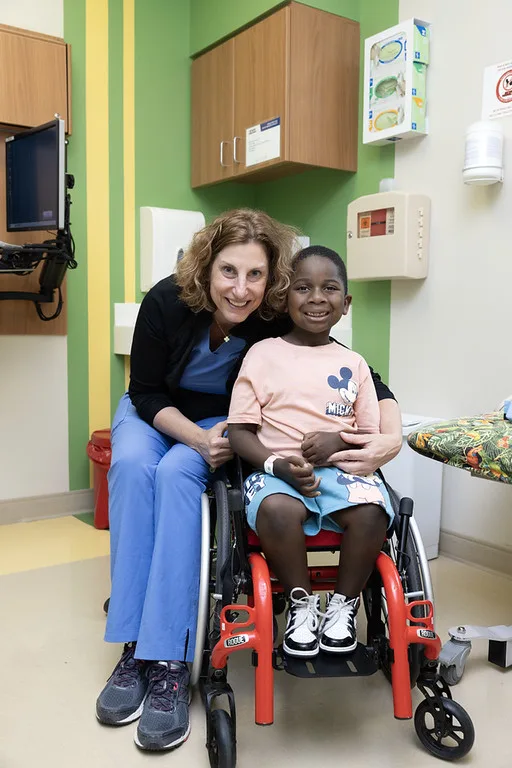
At Scottish Rite for Children in Dallas, Texas, where a breakthrough medical device was implanted in the U.S. for the first time, Dr. Amy McIntosh poses with six-year-old Kingston Brown. (Photo courtesy of Scottish Rite for Children)
Amy McIntosh, M.D., meets with patient Kingston Brown, age six, during a follow-up appointment after his scoliosis surgery. The boy was the first child in the United States to receive a new type of spinal implant. The procedure was executed by McIntosh, originally from Gladstone. (Photo courtesy of Scottish Rite for Children)
Dr. Amy McIntosh, formerly Bradfield, recently made history by becoming the first surgeon in America to implant a new device for children with spinal deformities. She grew up in Gladstone, Michigan. (Photo courtesy of Scottish Rite for Children)
Before and after scans show how a child's highly-curved spine has been corrected using the Cresco Spring Distraction System, which will expand as the youngster grows. (Courtesy of Scottish Rite for Children)
At Scottish Rite for Children in Dallas, Texas, where a breakthrough medical device was implanted in the U.S. for the first time, Dr. Amy McIntosh poses with six-year-old Kingston Brown. (Photo courtesy of Scottish Rite for Children)
Trending
DALLAS, TEXAS -- A medical device developed in the Netherlands and cleared for use by the FDA in January has successfully been implanted in a child in the United States for the first time. Performing the surgery at Scottish Rite for Children in Dallas, Texas was pediatric orthopedic surgeon Amy L. McIntosh, nee Bradfield, a 1992 graduate of Gladstone High School.
Developed for children with early-onset scoliosis, the Spring Distraction System, otherwise known as SDS, was described as a “dynamic growth-friendly implant” by the National Institutes of Health.
“It is designed to control the spinal deformity while allowing the spine to grow with the child, without extra clinic visits or radiographs just to adjust the device,” explained Dr. McIntosh. “What I love most is the possibility of giving children more time to enjoy being children and less time in a surgeon's office.”
The inventors are René Marten Castelein, professor emeritus of orthopedic surgery and professor emeritus of pediatric orthopedics at the University Medical Center Utrecht, and Moyo Chikondi Kruyt, professor of reconstructive skeletal engineering at the University Medical Center Utrecht.
Left untreated, early-onset scoliosis -- which is a three-dimensional curvature of the spine caused by various diagnoses -- “can cause progressive thoracic insufficiency and respiratory failure, ultimately leading to death. …Therefore, early intervention is important,” reads a portion of a 2022 report by the SDS inventors and researchers.
The need for a dynamic new product arose in Utrecht at the Dutch teaching hospital in 2015, when a six-year-old’s life was threatened by progressive scoliosis caused by a thoracolumbar fusion mass. No approved product for treatment existed.
“European and Dutch medical device law reserves a route for exactly this situation. A non-CE-marked implant may be used in an individual patient when no approved alternative exists and the patient’s health is at stake,” explained Cresco, the company founded by Castelein and Kruyt to manufacture the SDS, on LinkedIn.
The SDS met the need. In order to maintain uninterrupted spinal growth in skeletally-immature patients while providing continuous force to correct curvature, the device features compressed helical springs that fit around cobalt chrome rods. Rods are affixed via titanium pedicle screws and able to slide on connectors lined with polyethylene, says cresco-spine.com.
Following that first implant in 2015, the team entered the formal process to getting the SDS cleared to help more patients. A clinical study involved “investigational” implantations for research, all with informed parental consent and subsequent observation. The program was watched by doctorate students and industry professionals.
While other medical devices treat some symptoms that the SDS also targets, they also come with disadvantages. For example, frequent surgeries in children create concerns about mental development due to repeated anesthesia, and magnetically-controlled growing rods had a high implant-related complication rate, necessitating revision surgery after two years in nearly half of patients.
The early version of the SDS did also come with some complications. But data showed which aspects could be improved, and the design was modified.
The SDS was first patented in the Netherlands in 2017, then filed in the U.S. in 2020.
“After the FDA granted Breakthrough Device designation, another two years of engineering and regulatory work went into 510(k) clearance,” Cresco announced.
That clearance, which declares that a new medical device is safe and effective and allowed in the U.S., was announced on Jan. 19, 2026.
About 160 children have received SDS implants since they were first introduced in the Netherlands. But it was only a couple months ago that Dr. Amy Lynn McIntosh became the first surgeon to implant the device in the U.S. for six-year-old Kingston Brown.
Then Amy Bradfield, the accomplished doctor grew up in the Upper Peninsula of Michigan in Gladstone, where both Amy and her mother -- Claudia Bradfield -- said the education helped forge the woman’s future.
“Gladstone High School gave me an unbelievably strong foundation in math and science,” said Dr. McIntosh. “As a junior, I had two hours of inorganic chemistry lab every day. As a senior, I had two hours a day of trigonometry-based physics, including both lab and lecture. Those classes challenged me and prepared me exceptionally well for college. I carried that solid foundation through the rest of my education and training.”
After graduating from Gladstone High School in 1992, the former Amy Bradfield received her Bachelor of Science degree summa cum laude in Sports Medicine from Central Michigan University in 1996. She graduated with honors from Michigan State University College of Human Medicine in 2001.
McIntosh identified her calling during a residency at Mayo Clinic in Rochester, Minnesota, where she spent six months with the pediatric orthopedic surgery team.
“I loved the opportunity to care for the whole child, and I was struck by how resilient my young patients were and how well they could heal,” McIntosh said. “I also fell in love with pediatric spinal deformity surgery. Seeing what scoliosis correction could mean for a child -- helping them stand taller and straighter -- was awe-inspiring. I knew this was the work I wanted to do.”
Now a pediatric orthopedic surgeon, McIntosh has been practicing for several years at Scottish Rite Hospital in Dallas, where she is the professor of orthopedic surgery and the medical director of patient safety.
Scottish Rite for Children is a nonprofit pediatric orthopedic hospital that specializing in the treatment of a number of conditions and disorders in youth, from orthopedic conditions and sports injuries to arthritic and neurological disorders and learning disorders, such as dyslexia. Families are provided treatment regardless of their ability to pay.
One patient at Scottish Rite is Brown, a six-year-old boy with neuromuscular scoliosis and spinal muscular atrophy (SMA), a genetic condition that causes progressive muscle weakness. He and McIntosh made history when Brown became the first patient in America to receive the SDS implant.
“His care team selected the SDS because it provides continuous gentle spinal correction, which may reduce the burden of care on him and his family while helping preserve his sitting balance, comfort and respiratory function, all of which are key considerations in children with SMA,” read an article published by Scottish Rite for Children in June.
When asked what it was like to conduct the operation, “Much of the surgery was similar to procedures my team and I have performed many times, so we felt comfortable in the operating room,” McIntosh replied. “The new elements were the Cresco spring device and the instruments used to tension it. It was exciting to apply our experience to a technology that offers another option for children with early onset scoliosis.”
Now having accessed the breakthrough technology, Scottish Rite for Children is proud to offer another option for children with scoliosis, said Chief of Staff Daniel J. Sucato, M.D., M.S.
"This kind of innovation reflects our commitment to moving pediatric orthopedic care forward, helping improve outcomes while making treatment a little easier for children and their families along the way,” Sucato remarked.
“I'm very happy to offer the Cresco spring system to my patients with early-onset scoliosis,” McIntosh added.
As the hospital’s June release stated: “As new treatment options emerge, Scottish Rite for Children remains dedicated to evaluating and advancing innovations that not only improve clinical outcomes but also make care more manageable for the children and families who depend on it.”
– – –
R. R. Branstrom can be reached at rbranstrom@dailypress.net.